
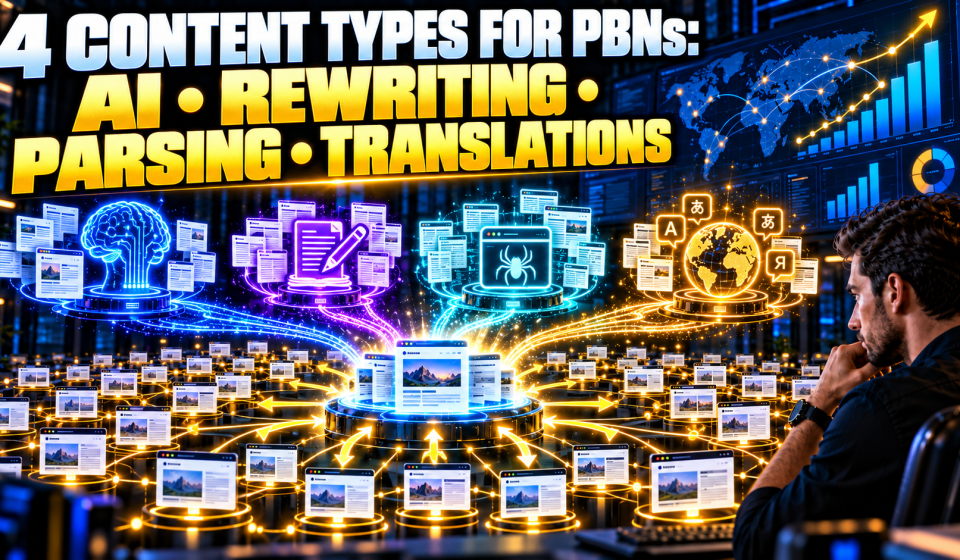
The 4 types of content I use to populate my PBN: AI / rewriting / parsing / translations

I’m continuing to show how I’m currently building my network of 500 PBNs in Ukraine. One of the main questions with such volumes is: where on earth do you get that much content from? As long as you’ve got 10 PBNs, there’s no problem at all. You just write using AI, manually upload 10 articles to each site, and everything’s fine.
But what do you do when you’ve got 500 of them and you want themed articles to appear on the site every day? It’s simple maths: 500 sites × at least 200 articles a month = 100,000 articles. If the average article is 5–7k characters, that’s already 600,000,000 million characters of content. Because I have absolutely no desire to set up a classic PBN where you buy a domain, install WordPress, upload 10 articles, add a link, and then the site lies dormant for the next three years.
My idea for PBN 3.0 is different. The site must constantly add new pages, update old ones, expand its semantic scope, generate impressions and, ideally, attract traffic. In other words, it should resemble a regular informational or niche website as much as possible, rather than a PBN. That’s why content is one of the things I’m currently automating as much as possible. I use four main approaches:
1. AI generation and scaling
There is a huge difference between “generating an AI article” and “building an AI-powered content production system”. Anyone can do the former in a ChatGPT session in 30 seconds. The latter is far more interesting:
🔷 you need to automatically identify the topic
🔷 gather the semantics
🔷 build the structure
🔷 write the content
🔷 create headings
🔷 add tables/lists/FAQs
🔷 select images
🔷 set up internal linking
🔷 choose a category
🔷 schedule publication
🔷 submit to search engines
What’s more, I don’t want 500 websites to look as though they were all written by the same AI chatbot. That’s why I use different prompts, structures, article lengths, writing styles, publication frequencies and content types. And most importantly – I don’t pay any attention to AI detectors. I couldn’t care less whether some detector shows 17% AI or 97%. I’ve got a much simpler detector – Google.
What I need is for it to index the page and generate impressions; then the search queries start coming in, the page stays in the index for 3–6 months, and organic traffic kicks in. For me, these are the standard metrics for content quality.
2. Rewriting – but not the sort of rewriting you remember from 2012
In the past, rewriting looked something like this: “buy a flat in Kyiv” – after rewriting: “purchase property in the capital of Ukraine”. We get a 97 per cent uniqueness score – which means the content is brilliant. These days, I understand rewriting to mean something completely different. There’s existing material that Google understands, indexes and possibly even ranks. We take it as a basis, but completely rebuild it. We change the structure, the order of the sections, the headings; we expand certain parts, cut out the fluff, add tables, facts, new concepts, images and so on. It’s even more interesting to take not just one article, but several documents on the same topic.
🔷 Take the structure from one
🔷 Take interesting facts from the second
🔷 Take a section from the third that the others don’t have
Then put all this together to create new content. The result isn’t just a mindless ‘rewrite of a competitor’s content’, but rather a synthesis of several sources. For mass content production, I much prefer this approach.
3. Parsing – one of the most interesting options for large volumes
I don’t view parsing as a way to ‘steal from a website’ at all. It doesn’t take a genius to parse 10,000 other people’s articles and upload them verbatim. For me, parsing is a way to obtain a huge database of raw material for further processing. Imagine I’m creating 100 websites on the same topic. I can gather thousands of relevant pieces of content from dozens of sources in advance, and then the rest happens automatically:
🔷 clean up the clutter
🔷 identify the themes
🔷 organise into categories
🔷 remove duplicates
🔷 extract key concepts
🔷 rework
🔷 distribute across websites
🔷 schedule posts
And this is where it gets really interesting. Once you’ve built the system, the production cost for every subsequent thousand pieces of content drops. That’s precisely why I’m currently spending so much time not directly on creating PBNs, but on the platform itself. I’m keen to build a production line where you can, for example, say: ‘Ukraine, motoring – we need to launch 100 PBN sites.’ From there, the platform and system handle as much of the work as possible on their own. Then, say, the next batch: ‘Germany – finance – 200 sites.’ And you don’t have to hire 15 copywriters all over again and explain the brief to each one.
- Translations – a goldmine in their own right
For some reason, this approach is used far less often, even though there’s a vast amount of content online in dozens of languages. Why limit yourself to searching for sources on Ukrainian Google for a Ukrainian website? There’s the US, Germany, Spain, Italy, Poland, Brazil and so on. You can find excellent material that isn’t available at all in the target region and then proceed to:
🔷 translate it
🔷 localise it
🔷 rewrite it
🔷 restructure it
🔷 add local entities/examples
🔷 publish it
And here, the key word is ‘localisation’, not ‘translation’. Because simply translating an American article about loans into Ukrainian whilst leaving in references to US banks, dollars and American legislation is obviously rubbish. But taking its structure and information and adapting it properly to the local context is a completely different story.
I’m not going to choose just one of these methods; on the contrary, I reckon the strongest option is to mix them together. I don’t need an article generator – there are already a million of those services – I need a content management system for the entire PBN network.
Creating 500 PBNs is a relatively simple task, but creating 500 websites that are constantly updated, indexed, receive impressions and traffic, and can be managed centrally – now that’s much more interesting. For me, that’s the difference between ordinary PBNs and what I call PBN 3.0.
Big hugs to everyone 🫂
__________________
Need backlinks? Send me a private message on Telegram: https://t.me/andrey_soroka
CIS and international markets (gambling, casinos, dating, crypto, and white-hat projects)
My channel about SEO, link building, and iGaming: https://t.me/info_site